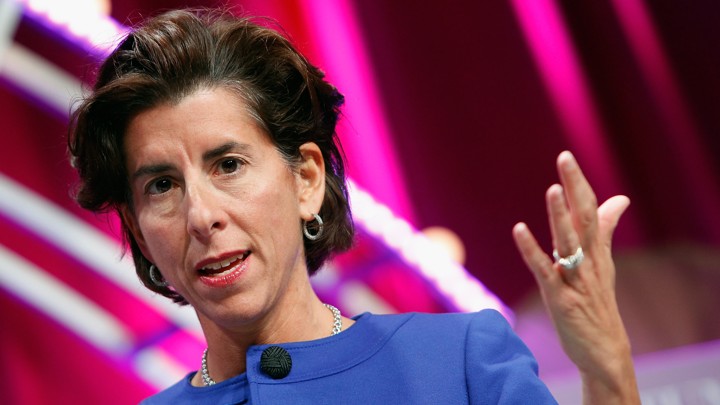
 “We have to go big here. These kids have been left behind too far for too long,” Rhode Island Governor Gina Raimondo said in an interview.PAUL MORIGI / STRINGER / GETTY
When Governor Gina Raimondo assumed office in 2015, “I knew that the Providence public schools weren’t where they needed to be,” she told me in a recent interview. The Johns Hopkins report made clear the extent to which that is an understatement. “We do have a crisis on our hands,” Raimondo said.
Now Raimondo, alongside her education commissioner, Angélica Infante-Green, is taking a dramatic step: Taking over Providence’s public schools. The state will assume control of the district for at least five years, beginning November 1. Infante-Green will oversee the district’s budget, personnel, and programming. “Because of the magnitude of our problem here, everything has to be on the table,” Raimondo told me. “We have to go big here. These kids have been left behind too far for too long.”
Read: Could a state takeover help Chicago’s struggling public schools?
In late July, armed with the results of her public outreach and the report from Johns Hopkins, Infante-Green went to the governor and requested the takeover. In her final takeover order, Infante-Green reasoned that the state and federal government had substantially increased funding for the public schools in Providence since 2011—a year after a new funding formula was implemented; and in the past five years, the state appropriation to the school district had increased by $40 million, and yet the district continued to chronically underperform. (Though critics argue that the formula short-changes English-language learners.) The solution, state officials argue, has to be more than funding.
This isn’t the first time serious issues have been identified in Providence’s public schools. When Domingo Morel’s family moved to Providence from Union City, New Jersey—which had narrowly avoided a state takeover of its own—in 1993, another bombshell report on the poor state of the city’s schools had just been released. “Providence Blueprint for Education” detailed concerns similar to today’s: a lack of school safety, questions of equity, problems with the English learning programs. Morel, who was in high school at the time, remembers the schools being in rough shape.
The 1993 report, which took a year to prepare, was meant to be a nudge—“a message of encouragement, not despair.” The business leaders and educators involved in putting it together wanted to be “perceptively honest” about the schools in Providence, and work to fix them. But when I asked Morel, who is now an assistant political-science professor at Rutgers who assisted the Johns Hopkins team with this year’s report, about what had changed between then and now, his response was simple: “There’s really no difference.”
The benefits of school takeovers are always uncertain—there have been more than 100 state takeovers since New Jersey first took over Jersey City schools in 1989—and any number of things can derail the path to success: The state could misdiagnose the city’s problems, set impractical deadlines, or look to the wrong experts. But one of the biggest potential pitfalls for a state takeover is the failure to involve the community in the plan. Although Raimondo is, according to one poll, the least popular governor in the country, when it comes to the Providence takeover, she has received significant support from political leaders and top educators. The mayor of Providence announced that he supported the takeover; so did the city council, the school board, and the district superintendent. In his book on school takeovers, Morel calls these kinds of situations “cohesive state-local regimes,” where there is a strong relationship between the governor and the mayor of the city being taken over. Typically, these leaders are members of the same party. “The signals that are sent to the community [by this type of agreement] are that this is not going to be the same type of intervention that we’ve seen in other places,” Morel told me.
But students, parents, and advocates in Providence still have concerns that they may not have a formal role in the process. That disconnect between the community and those conducting a takeover, the ever-present danger of an us versus them mentality, can quickly hamper the effort. In Little Rock, Arkansas, for example, that sort of divide between state officials and the community over a recent school takeover has resulted in tense, passionate meetings and protests. The community doesn’t seem to have many objections to the takeover itself in Providence—so much attention has been paid to the state of the schools that most agree something needs to be done—but citizens do want some say in how the takeover will be conducted.
“Nothing about us, without us, is for us,” Elliot Rivera, the executive director of Youth In Action, a student advocacy organization, told me. The students who were a part of the organization, he said, had been vocal about the issues in the school system for years, and with the announcement of the takeover, the government was naming those same things as problems it wanted to fix. It was an opportune time: “Let’s work together to come up with solutions that feel equitable for all of us.”
Read: An attempt to resegregate Little Rock, of all places.
So in September, a group of organizations, including Youth in Action, filed a petition for a formal role in the creation of the takeover plan. The state ultimately denied the petition, but Infante-Green stressed to me that community members would have “official roles” in the plan, though it’s not yet clear exactly how. Last week, Infante-Green released the details of her takeover plan. She has selected a superintendent to lead the turnaround effort, but she wrote that she will “afford students and parents sufficient opportunity to measure the progress of the plan, [and] afford relevant stakeholders, including students and parents, sufficient mechanisms to express their opinion on material decisions.”
When I spoke with Governor Raimondo, she wanted to stress that community involvement will be paramount to the success of the takeover. “If we come up with some turnaround plan from on high and try to impose it on the community, that won’t work,” she told me. “That’s true of most things. Everything I’ve done as governor that’s been successful has been very bottom-up.”
The state has given itself a five-year timetable for the plan, and the margin for error is large. As Emily Richmond wrote in The Atlantic, there’s a fundamental tension at the heart of school reform efforts: “It’s not a question of who’s in charge but what they do with that authority once they have it.” In the introduction of the 1993 report, Edward D. Eddy, the chair of the commission, closed with optimism. The schools could improve, he wrote: “Yes, it can happen here.” But it has not happened yet. Everyone hopes it’s still possible.
JOIN THE MOVEMENT #iBELIEVE
 Standing Strong for Public Education!